Discovering the Mediterranean coast of Spain in the early 1970s
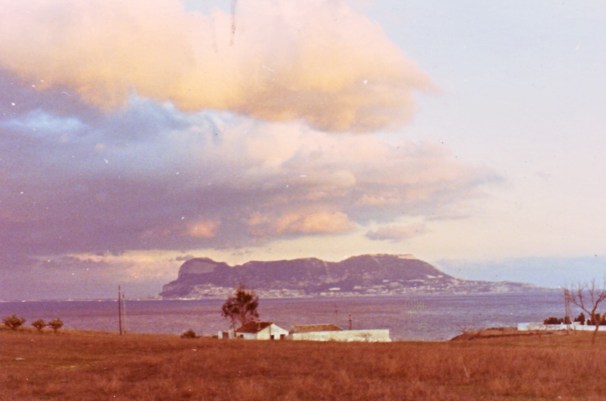
It was February 1970 and as part of a backpacking adventure from London to the south of Spain a group of eight Australians had met up at Malaga.
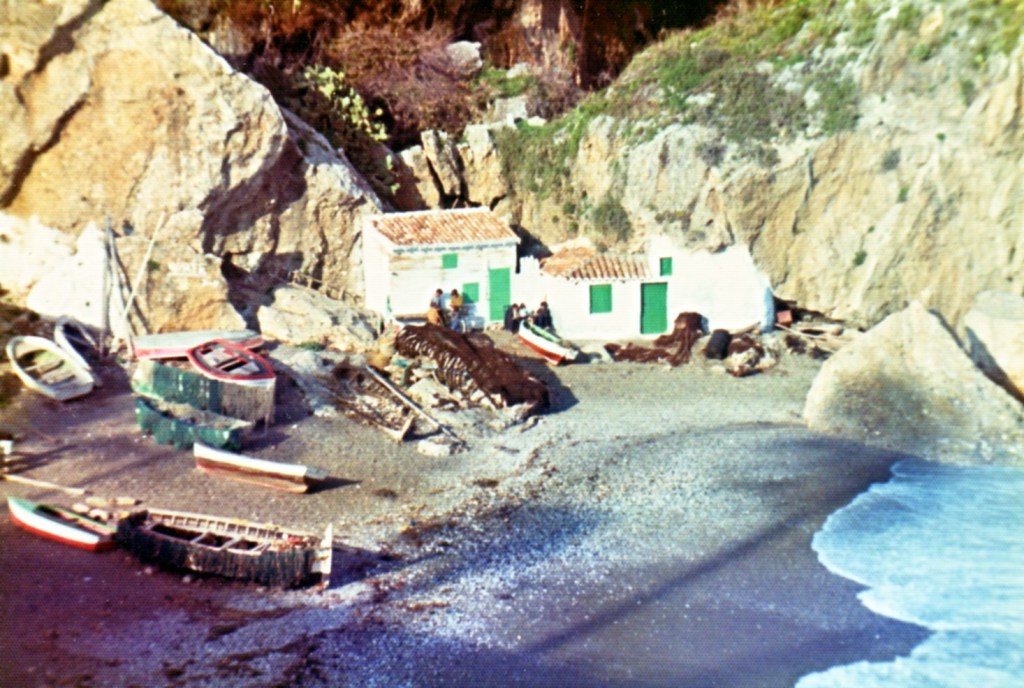
We were staying at a villa at Rincon de la Victoria – right on a rocky headland overlooking the Mediterranean Sea.
Being the end of winter there was still snow on the Sierra Nevadas – the mountain range that dominates the south-eastern corner of the Iberian Peninsula and formed a dramatic backdrop to this region.
Highlighting the weather at this time, we swam in the Mediterranean about 20 days out of the 30 … sometimes catching a wave on surf mats that were to be used in the swimming pool at the villa.
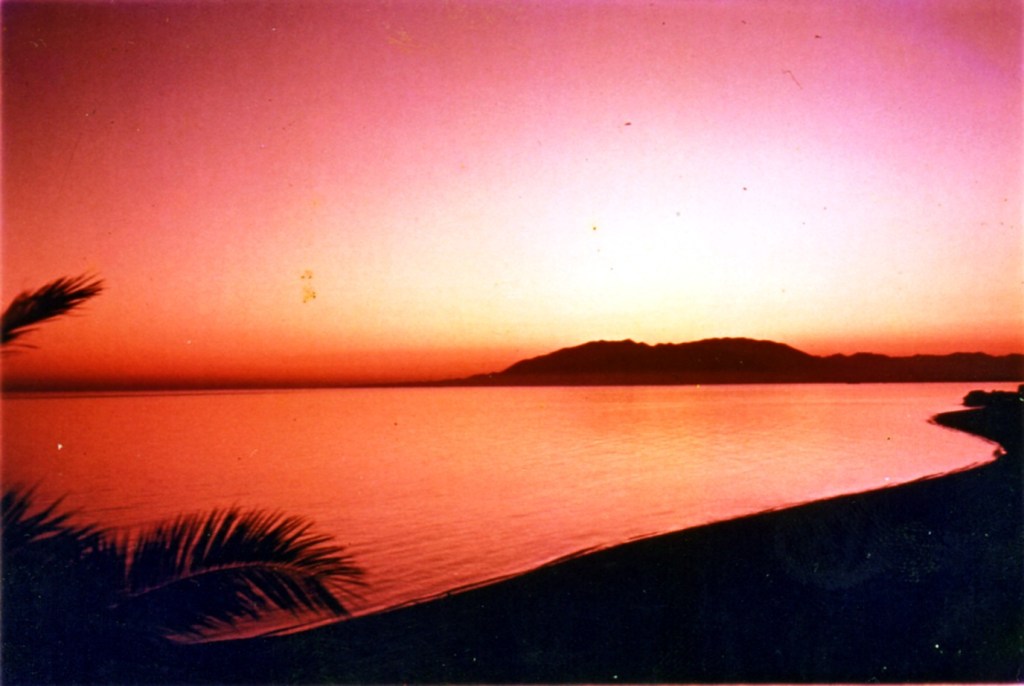
All of this at about $7-$8 a week for each of us to rent the villa. Food and drinks were on top of this, purchased each day in the fishing village.
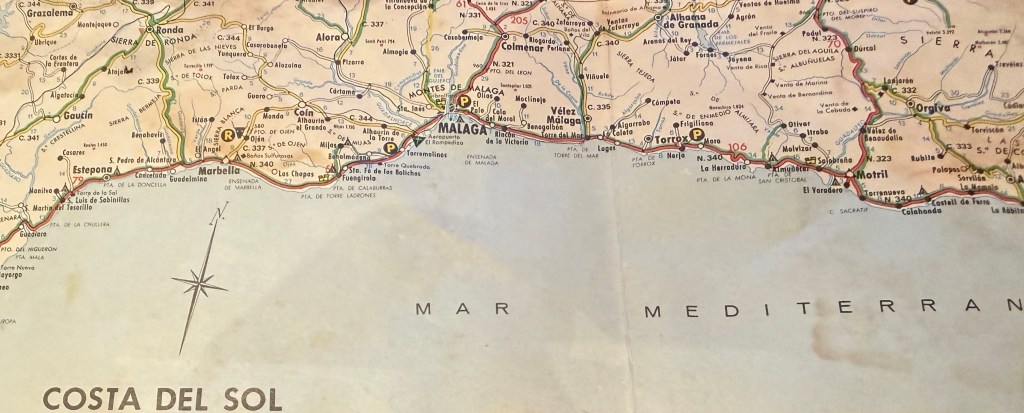
It was a time when we had to rely on paper roadmaps, picked up from tourist information centres or hostels – folded in three then in half so as to fit into a backpack.
A lot of the time you relied on other travellers to talk about places to see, places not to bother with.
At Rincon, we would take off for a few days, such as a short Morroccan adventure. That involved a ferry trip from Algeciras to the Spanish outpost of Ceuta in Northern Africa then by bus to Tangiers.
What an interesting experience – such a difference that crossing the stretch of water the Strait of Gibraltar could make.
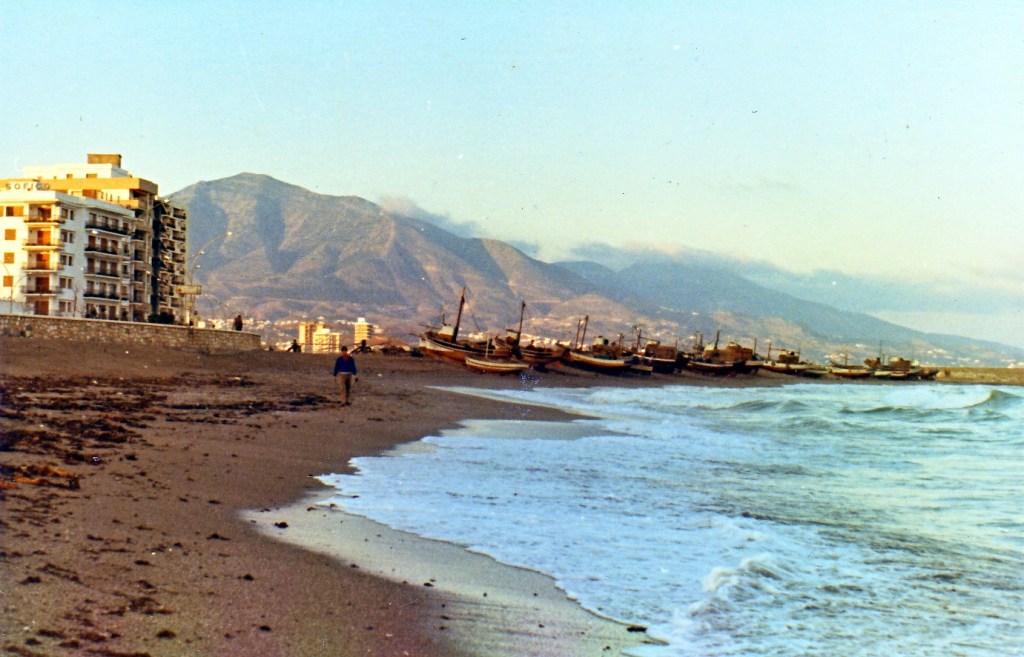
Enlightening in so many ways. The distance was about 30km and took about two hours I think.
It was a large ferry … bigger than the ferry from Circular Quay to Manly on Sydney Harbour.
While the swell rolling in from the Atlantic Ocean was mild compared to some of the Many Ferry crossings it still upset a lot of passengers. We could only imagine that few in the 1970s crossed between Europe and Africa in those days.
The decks were literally awash with the results of seasickness on our crossing.
It was a matter of looking directly at our companions and talking our way across … even though as Australians we were more used to these conditions.
However, it was a sunny day and we made it safely.
We had set foot on African soil on our voyage from Australia to the UK when the ship docked at Cape Town.
From the deck, I will always remember – not the different buildings and the mountain ranges but the black horse-drawn coach that was obviously part of a funeral procession.
The four-wheeled coach had glass on the sides and veiled curtain fringes. Four black horses in front with black feathers on their heads.
Two men dressed in black, sitting in the driving seat with reins in their hand.
The coach and horses were stark against the pale colours of the quay. A moment etched in my mind.
There were six of us. I remember that at the time there was friction between the Spanish and British governments over Gibraltar.
With evidence of habitation dating back 50,000 years, the a 426-metre-high limestone promontory, the Rock of Gibraltar, is said to have been visited by the Phoenicians around 950BC, and considered by the ancient Greeks and Romans as one of the Pillars of Hercules, after the Greek legend of the creation of the Strait of Gibraltar by Heracles.
Settled by the Moors in the Middle Ages and later ruled by Spain, Gibraltar was ceded to the British in 1713.
Gibraltarians overwhelmingly rejected proposals for Spanish sovereignty in a 1967 referendum, and for shared sovereignty in 2002.
However, on our adventure the journey from Ceuta to Tangier was by bus and instead of the coastal road we went isouth to Tetouan.
Again, with a long and celebrated history, it is in a rich farming area.
In 1913, Tétouan became the capital of the Spanish protectorate of Morocco, and it remained its capital until 1956.
France and Spain had both established protectorates and designated Tangier as an international zone, until Morocco reunified in 1956 with Rabat as the capital.
The old city of Tetouan was built around a casbah or fortress, and mosque .
The term casbah has taken on the meaning of medina or central market, and since 1997 this area has become a UNESCO World Heritage Site.
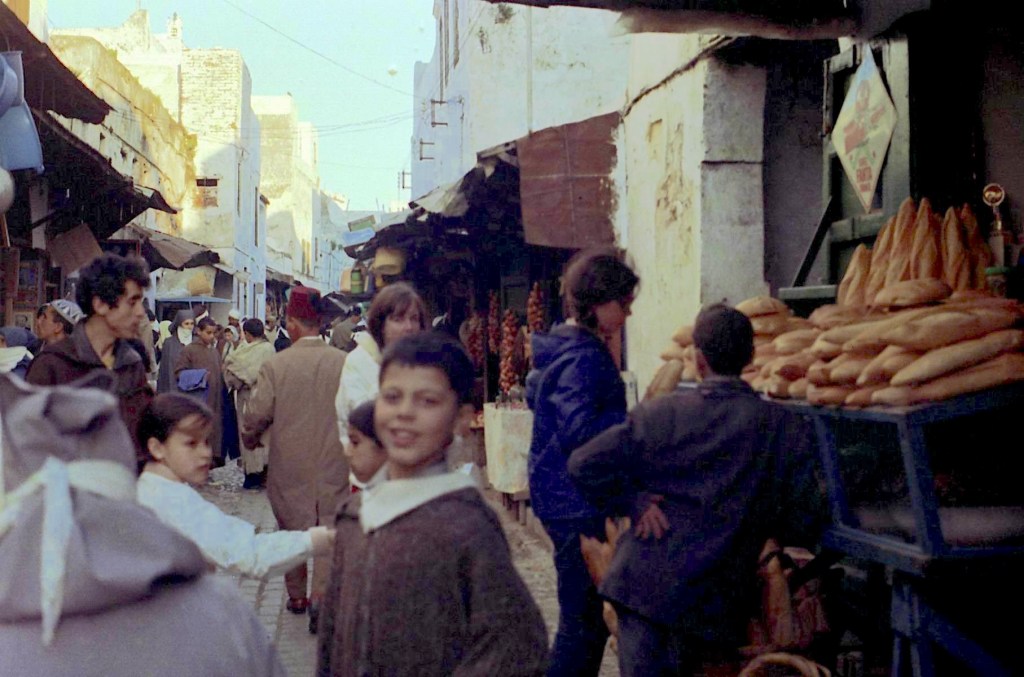
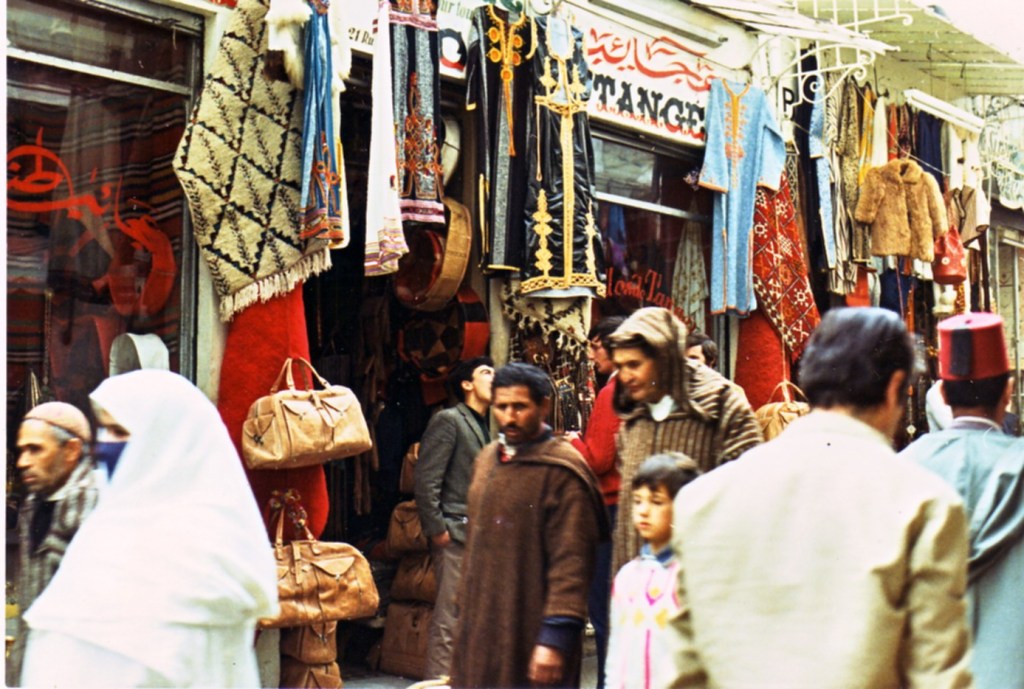
It was into this collection of laneways and alleys that we found ourselves, surrounded by shops and market stalls of all shapes and sizes with traders selling everything and anything from carpets and souvenirs, from spices and fresh produce to ornaments and all sorts of clothing – finely embroidered women’s clothing, colorful Berber garments, and the hooded djellabas so common in the area.
It welcomed us to the world of bargaining – something we were not used to.
Mick had studied it and told us something like see what the seller is asking, offer a third of the price then be prepared to increase it to half.
Viewed more as an experience than a hostile battle about price, the aim is to agree on a mutually respectful price – and have some fun in the process.
The trouble was, Mick started with an offer of 30 percent … and the mercant agreed, leaving him with nowhere to go.
It was a learning experience for everyone involved.
Then came the time to catch the bus to Tangier, and our helpful guide – a teenager studying at university – left it up to his colleagues to direct us through the maze of streets to the bus station. For a small “donation” or gratuity.
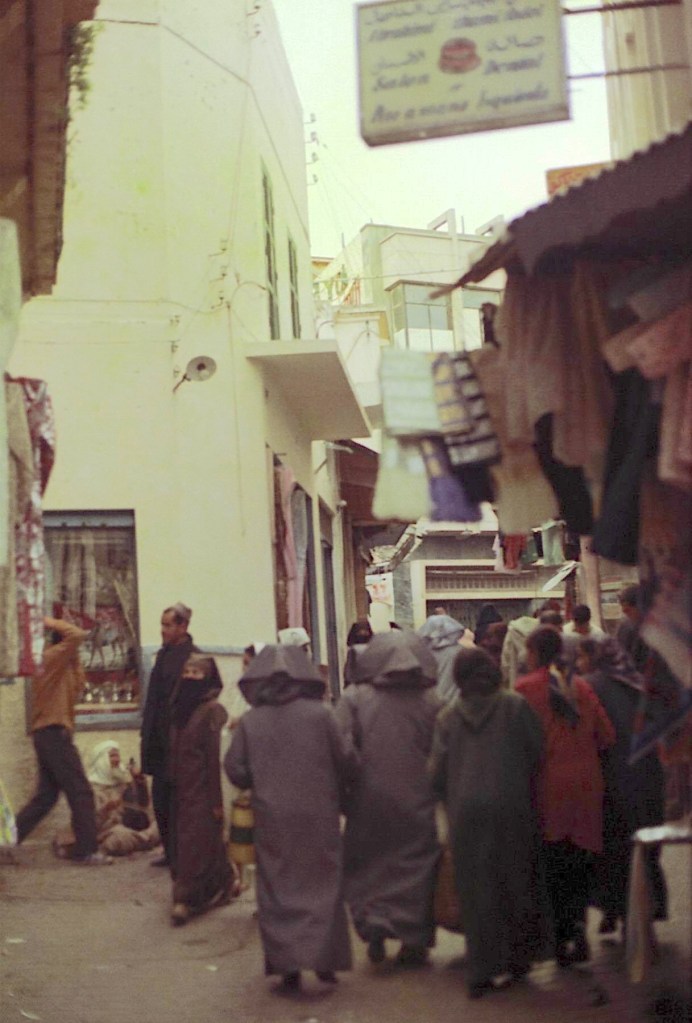
At Tangier, Ron and Patsy headed south to Casablanca and then the famed “red city” city of Marrakesh, known for its stunning backdrop of the Atlas Mountains.
While Casablanca is Morocco’s largest city, Marrakesh is famous for its red-pinkish clay buildings. Both share many references in Hollywood movies but also for the number that have been set there.
Back in Spain, Ron and Patsy told of their extraordinary adventure – of getting a ride with two Moroccan men to a remote beach.
Such is the way of the hitchhiker, apprehension turned to excitement as the men told of how Australian surfers had taken advantage of the then virtually unknown Atlantic Ocean waves breaking at Anchor Point, near Agadir.
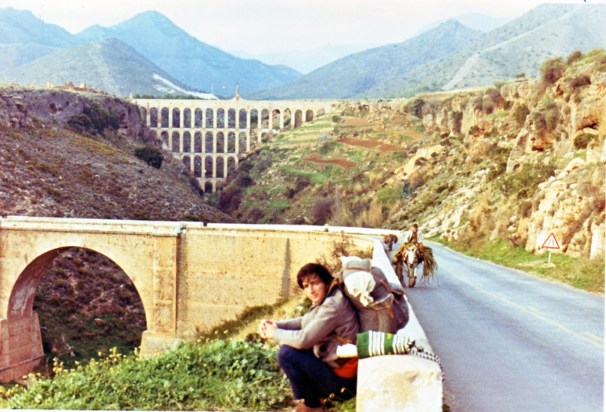
But closer to home, Mick and I walked along the coast to Nerja, past incredible aquaducts to the the magnificent caves where Segovia played his magical guitar.
The caves are one of Spain’s major attractions and have since found to contain cave paintings dating back 42,000 years.
There are giant stalactites and stalagmites in the caves, and skeletal remains indicate the caverns were inhabited from about 25,000 BC.
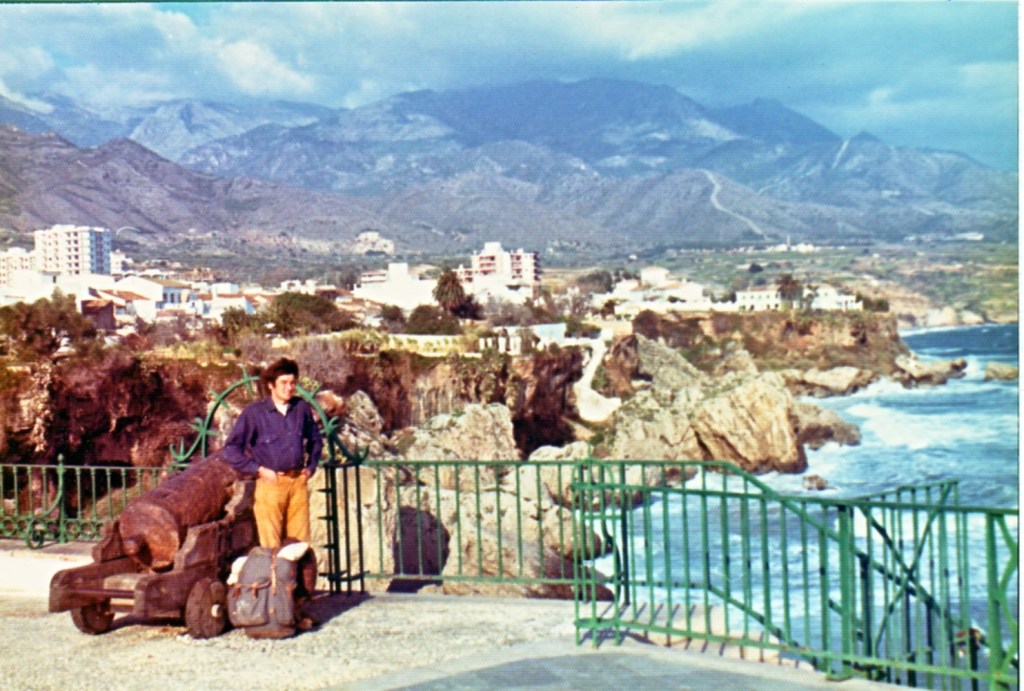
Days later, we took a bus back to Mijas – towards Gibraltar. It’s a beautiful little village in the hills behind Fuengirola.
There was a cockatoo outside a bar cafe and this American woman kept telling her son and husband: “Hey, Harry. Look at the parrot.”
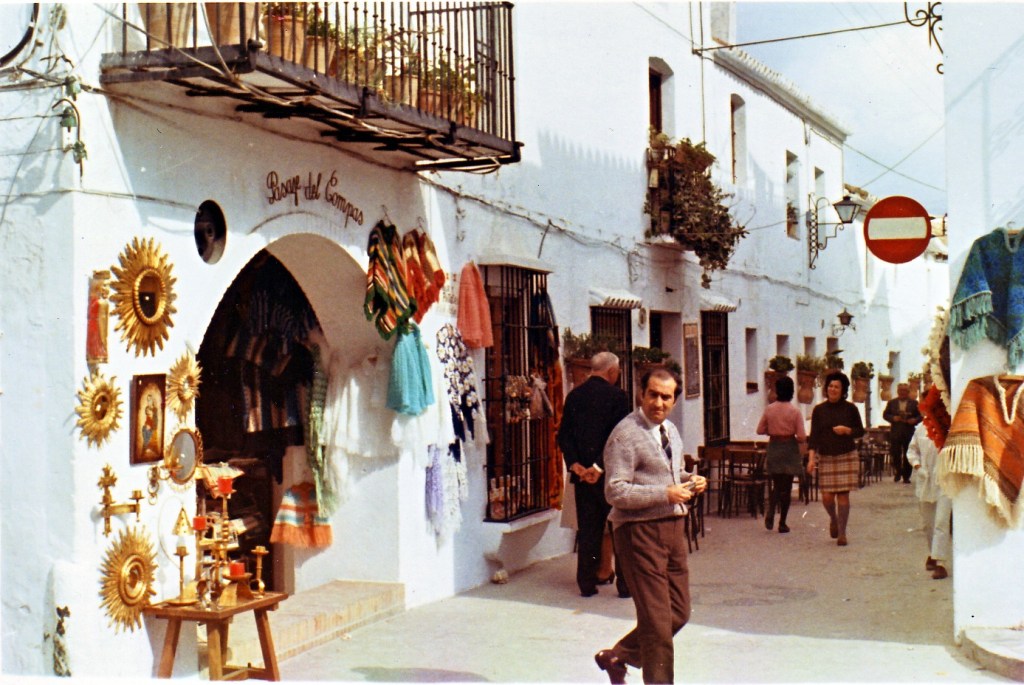
Mick and I smile. Then start walking down the range towards Lew Hoad’s Tennis Camp.
It’s a beautiful sunny day. Birds sing high up. Olive groves and citrus orchards.
Lew Hoad was a champion Australian tennis player and his Campo de Tennis had just opened, presenting a great venue for aspiring tennis players to train, as well as celebrities and friends of the Hoads to visit – actors, writers, musicians and fellow sporting identities.
Coming up the road toward us was one of the Guardia Civil. The police who were placed in power by Franco to keep the peace after the civil war.
Their uniform included a distinctive little three-cornered cap. There were stories from fellow travellers of a drunken American grabbing one off a guardia’s head. So he shot him.
We were on opposite sides of the road but from 400m away we know he was going to stop us.
Sure enough, as we drew level he called to us and asked our business.
“We are going to see Mr Hoad,” I tell him.
“Ah, Mr Hoad. Why?” he asks.
“He is a friend … amigo, ” I reply.
“Amigo.” So he leads the way for us to Mr Hoad’s Campo de Tennis.
Now I’m starting to think he doesn’t believe us and is going to call our bluff.
Little does he know I once worked as barman and in the bottle shop at the Isle of Wight, the hotel owned by Tennis Inc at Cowes on Phillip Island. I think it was Rosewall, Hoad and one other from the golden era of Australian tennis. Then again it could have been Tony Trabert, an American.
My hitch-hiking mate from Australia, Trevor, had even umpired a tennis match there. It was supposed to be a social match between old friends and included the fiery South American Pancho Gonzalez.
Trev made a bad call and Gonzalez cracked up. It was then he realised they were playing for quite substantial stakes … even if it was among friends.
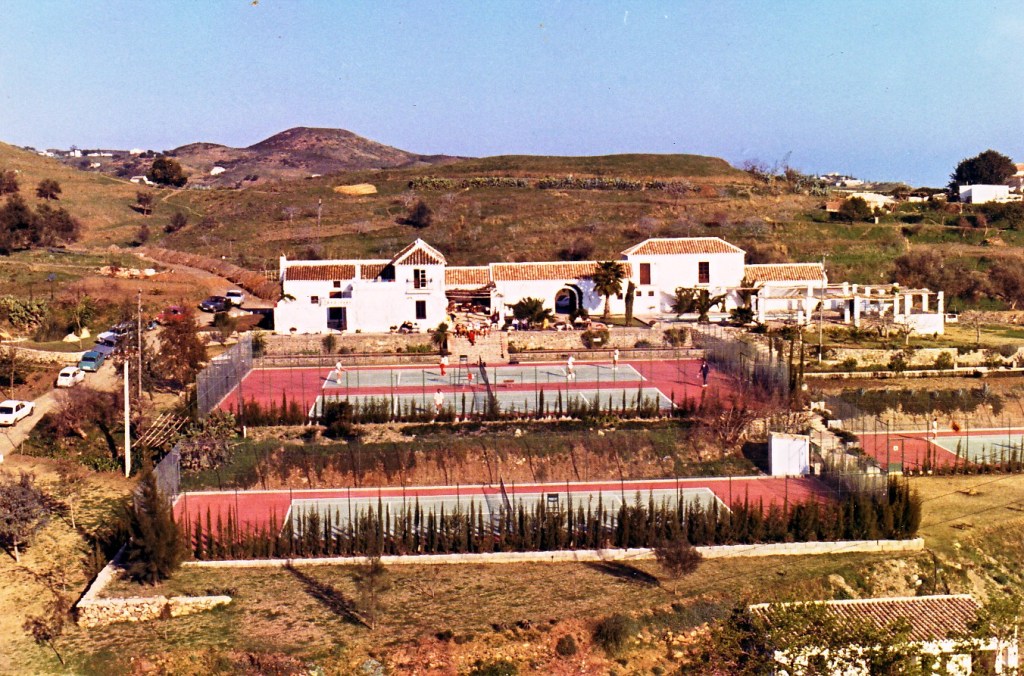
On this day our guardia friend only walks us to the gates and we continue down the sweeping drive, past orange trees to the dozen or so tennis courts.
We don’t go any further. Just rest a while and take some photos. We don’t want to push our luck.
We camp at night at Fuengirola and pass time with a talented young American who played jazz on flute and clarinet, had a little dog as a travelling companion and was very open in his outlook of the world.
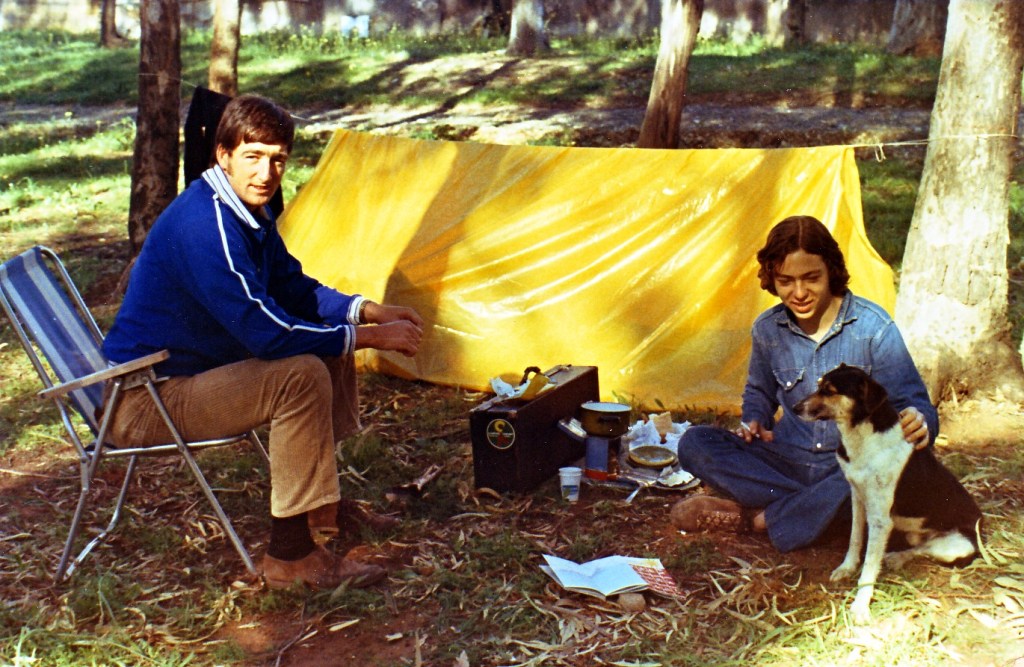
Something I found unusual about Americans I have met so far. Generally they are nice enough but quite inward looking. Introspective.
The next day we walk to Torremolinas then catch a bus back to Rincon.
A way to understand the culture and architecture of a place is to attend a mass in the village church, along with the fishermen, the farmers and the business people.
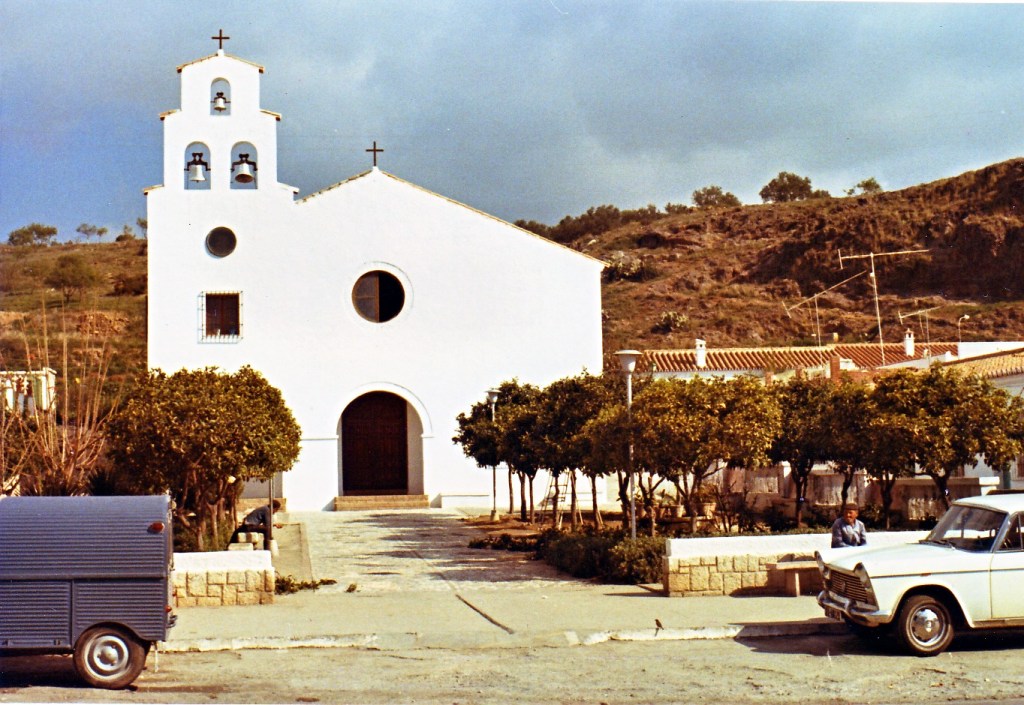
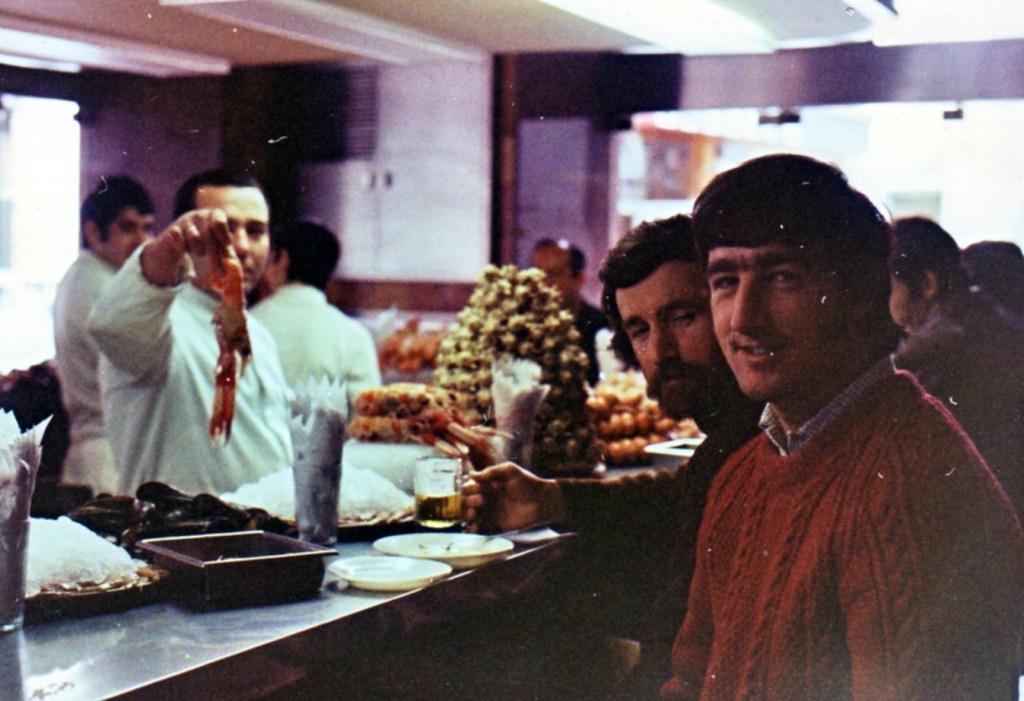
For a small village, it turns out to have a lot of bar-cafes. One night, we set out from the furthest bar and worked our way back towards the villa. Tapas here, vinos there, beers at 17c a litre bottle. There were at least a dozen, possibly 13 bar-cafes.
At the last one we grab three litre bottles of beer and head off up the peninsula, trying to open the bottles as we go.
Fuzzy heads the next morning so it’s a matter of spending the day lazing in the sun, reading.
Soon after returning from Morocco some Americans stopped by for a few days and left a copy of Iberia. It’s written by James Michener and the biggest book I’d ever attempted. It’s set in the 1930s before Spain’s Civil War.
A fascinating insight into that turbulent part of Spanish history, and takes the reader inside village life.
The Americans, by the way, had sailed across to Europe. Their yacht was at anchor in Malaga harbour.
They intended to sail to Morocco, load up with drugs and return back across the Atlantic. Not take any drugs in. Just use them all up on the crossing.
They warn me that Iberia is still banned in Spain under Franco’s regime, so be careful with it.
It reminded us of the two Aussie girls we met in Morocco who had been picked up by the police. Smoking dope – which is OK in Morocco – but you don’t do it right in the open.
They got out of the lock-up but claim the police kept their dog. Weird story. Like I’d been told in England by a merchant seaman who had served in World War Two: Trust everyone but trust no-one.
You just don’t go about drunk or on drugs in unlikely places. Especially if you are in a strange land.
Meanwhile, the long rugged hill to the west of our villa has remained a constant attraction. So much so that a few of us hike up there to fully appreciate the outlook.
A few days later Trevor set off for Morocco with Peter and his parents. They had a car and picked Trevor up then headed for the ferry crossing at the Straits of Gibraltar.
It was a time when long-haired males were not welcome in Morocco so they came back with a story about having to stop by the roadside at the border so that Peter could give Trevor a haircut.
That reminded me of the popularity of the 1970s Lonely Planet travel guides that were essential for backpackers – especially the chapter about the benefits of paperback editions.
The contributor was stuck on the roadside in Northern Africa, suffering from a bad case of diarrhoea – a common issue when travelling and especially in the more remote areas.
The traveller was busily reading the chapter on the causes, effects and how to deal with the problem.
Page after page after page. It was a matter of reading quickly so as to rip the pages out and use them when stuck on the side of the road in such a situation.
As February drew to a close it was time to load up the van and that somehow six of us fitted in and we headed north along the coast.
We were headed for Barcelona. From there the four who had travelled from London in the van would continue on to the south of France and into Italy.
That left Trevor myself to catch trains up to Paris and then back to London.
No more back-packing at this stage. An on-going postal strike in Britain meant no money transfers – not even general post.
So it was a matter of working out the train fares, cost of food and see if we had enough money. One travellers cheque each. One for $10 and another for 10 pounds.
That saw Trevor donate blood – another $20. We could afford a few hours in Paris and catch the boat train that night for London.
At that time resourceful expatriates living in Britain were collecting suitcases full of mail and flying back to their home country then posting the mail there.
Simple. They got to see friends and family, and the fare was paid for by carrying the mail – by air.
When there was a power strike, people would cross the English Channel by ferry and bring back suitcases of candles.
Our journey by van along the Costa Del Sol then the Costa Blanca took us past the caves of Almeria that had become so popular with hippies and artists to stay in.
Instead, we slept on the beach and then wake to watch the fishermen hauling their nets in.
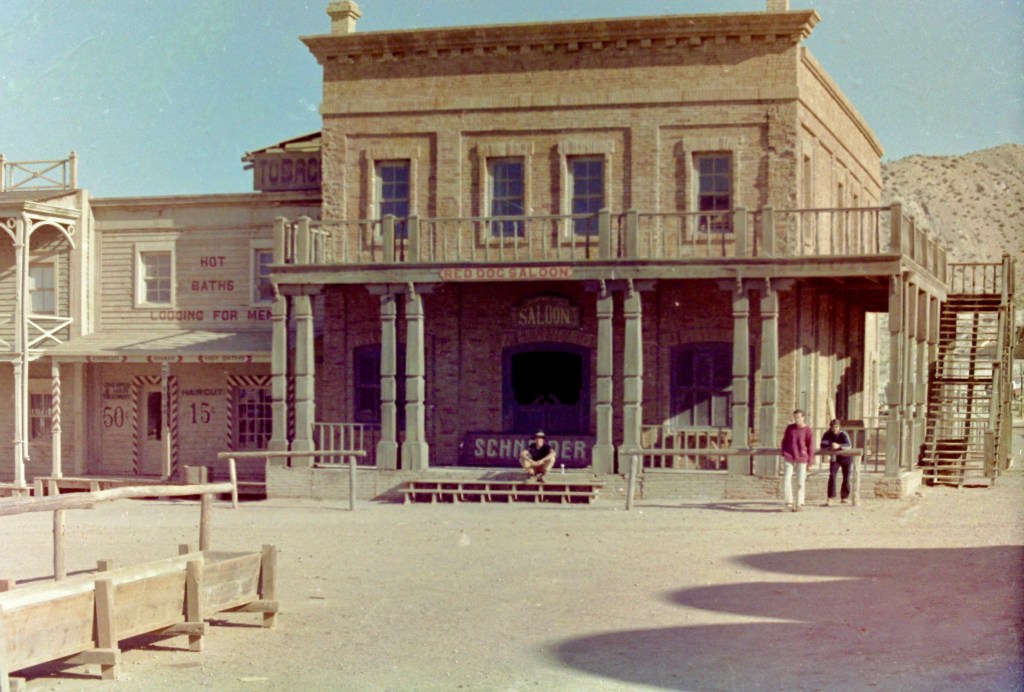
That day we headed for the movie lot where so many spaghetti westerns were filmed. What was that movie they were shooting at the time? Racquel Welch I think. A western with Kenneth More as the English greenhorn.
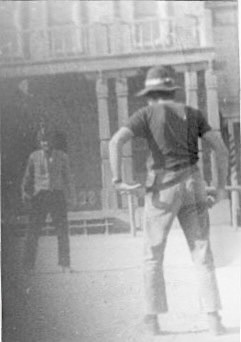
There’s a whole town set in the desert hills. There’s no filming on the day so it’s our chance to strut upon the stage. Gunfight at the Red Dog Saloon.
It’s a hot morning and we leave Boot Hill to push on to a little village near Murcia for lunch.
It’s market day and we have cold white beans on bread, milk, bananas in a crusty roll and washed down by vino.
That night we sleep among the orange groves at Valencia. Get a campfire going and we sing, eat rolls filled with tomatoes and cheese then toasted on the open fire. Vino tinto topped the night off.
Valencia was the stepping off point for Michener when he started his Iberian adventures. There was nothing to commend it then. Nothing to commend it now … except for the legacy of the name, Valencia. All of those oranges. All of that marmalade.
There are more oranges here than I have seen in my life. So we grab some for travelling.
The next day we reach Campello and meet up with Peter at the bar-cafe by the sea he virtually had made his own.
His parents were back in Britain by then so we enjoy a few beers, a game of pool, and see ideas of how to make souvenirs that sell themselves.
Breakfast in Spain was always enjoyable – generally of cafe con leche and those cute little custard-filled donuts.
That afternoon we set up camp at a ground on the outskirts of Barcelona and catch the subway into the heart of this beautiful city.
It was the centre for the republican forces in the civil war. Today it is still an important cultural centre. The heart of Spain. Not the capital. That is Madrid but from all accounts that, as a city, it has as much soul as Canberra, Washington or Edmonton.
We walk up to the castle and look over the harbour by night then make our way down to the wharves at the Old Port and the fantastic bar-cafes that seem to be everywhere.
We fall into one and head upstairs. It’s crowded, it’s noisy, it’s full of life. People sitting on timber benches at tables.
Paella is the main dish … with lots of wine. There’s a guitarist and we put Trev on the spot by telling our new friend that he can play.
It’s a great night. Apparently Barcelona have won their Spanish league soccer match that day so the sounds of their supporters were ringing out loud and clear.
We must have caught the last train home.
The next day we are back in the heart of town and walking along the Ramblas … it would have to be one of the great esplanades in the world. So many people out walking, enjoying lfe.
It’s a people’s mall with streetside bar-cafes. We are heading for our first bullfight. There are similarities with Australia … such as making your way to the Melbourne Cricket Ground for a Test Cricket Match or to the Australian Football League match of the day.
So we stop at a bar to ask directions. Not that we need them … it’s a stream of people descending from all directions on the bullring.
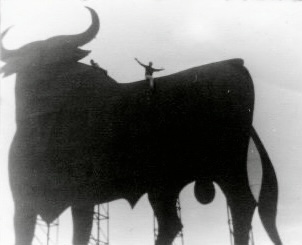
But it’s a good decision. The barman says to wait for a while and he will explain the ritual to us.
I have been apprehensive about whether to go to a bullfight or not. Probably if I was travelling by myself I wouldn’t have. But then again, how can you tell if you don’t go.
Like the two Pommies who said they didn’t like America. Well, they thought two hours in the airport terminal at Los Angeles should have been good enough for them to tell.
Our barman friend is quick with the beers and the television behind the bar is tuned to the bullfight. True to his word, he enlightens us on the intricacies of the sport.
In Ernest Hemingway’s documentation of bullfighting, particularly in Death in the Afternoon, he viewed the matador as an artist whose work is constantly in danger of death.
It is a highly polarising sport. For aficionados it is a tradition and celebration of culture. For critics, it is animal cruelty as the bulls are tortured, and weakened by lances before the matador even enters the ring.
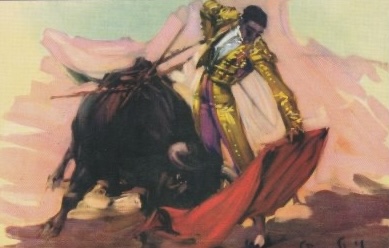
Michener describes the intense, ritualistic life of bullfighters and mentions the light, energy-dense, and easily digestible items they eat prior to the fight to manage the intense fear they must face.
Michener describes how creme caramel was a common, perhaps the preferred choice of food, for bullfighters before entering the corrida.
Still popular in regions such as Andalusia, Madrid, and Navarra, bullfighting was banned in the Canary Islands and in Catalonia, which is where we were in Barcelona.
The Plaza de Toros Monumental de Barcelona was the last bullfighting arena in commercial operation in Catalonia. That was in 2011 after a ban was passed by the regional parliament – some were citing animal rights but others wanted to differentiate Catalonia from the rest of Spain.
Yes, quatro cervezas, por favor.
We have really settled in. There is even a glimpse of Franco on the TV as he settles into the presidential box. Definitely not one in the sun.
That’s been another good reason for watching from the a barstool instead of the concrete benches in the stands … the television is in black and white, not colour, so you don’t see the blood on the sand.
Just like the football, there are the warm-up events where the novice bullfighters get their chance to show their skills. Unfortunately they are a bit scrappy. One is downright messy.
Cuatro cervezas mas, por favor.
The next matador is a hot young gun who gets us cheering with his bravado. He delivers the final thrust … right up to the hilt of the sword. Magnificent.
Then there is the master. His name is even on some of those atypical Spanish bullfighting postcards.
Was it El Cordobes? I have a life-size poster with him on it somewhere in the old files. I’ll have to rummage through them and get it out. Classic.
On that day he used grace and experience to completely mesmerise the bull. It was a dance … a waltz rather than a tango. Ole.
Snow is gently falling the next morning as we break camp and head north along the Costa Brava, then the Gerona valley to the French border.
 leavearly