From the mountains to the sea … a journey that will live forever
Waking after eight hours of deep sleep in the cosy little hotel in Guarda we are warmed by the hospitality shown in this rather isolated municipality in northern Portugal.
At a little more than 1000 metres above sea level, it is the highest city in Portugal.
We had arrived by train the day before from the Spanish border amid snow and rain.
Being in the early 1970s, it was a time before smart phones and cash cards.
Our travels were controlled to some degree by the ability to cash travellers cheques. Train times were found on printed timetables at the railway stations.
There were four of us – two Canadians and two Australians – and we had shared the various rail journeys from the coastal areas of northern Spain into this stark winter’s landscape.
Next stop, the Portuguese capital of Lisbon on the western coastline.
The first thing was to get some money at the bank then walk the three or so kilometres to the railway station. Downhill this time.
Away from this city in the hills … caught between countries, caught between times.
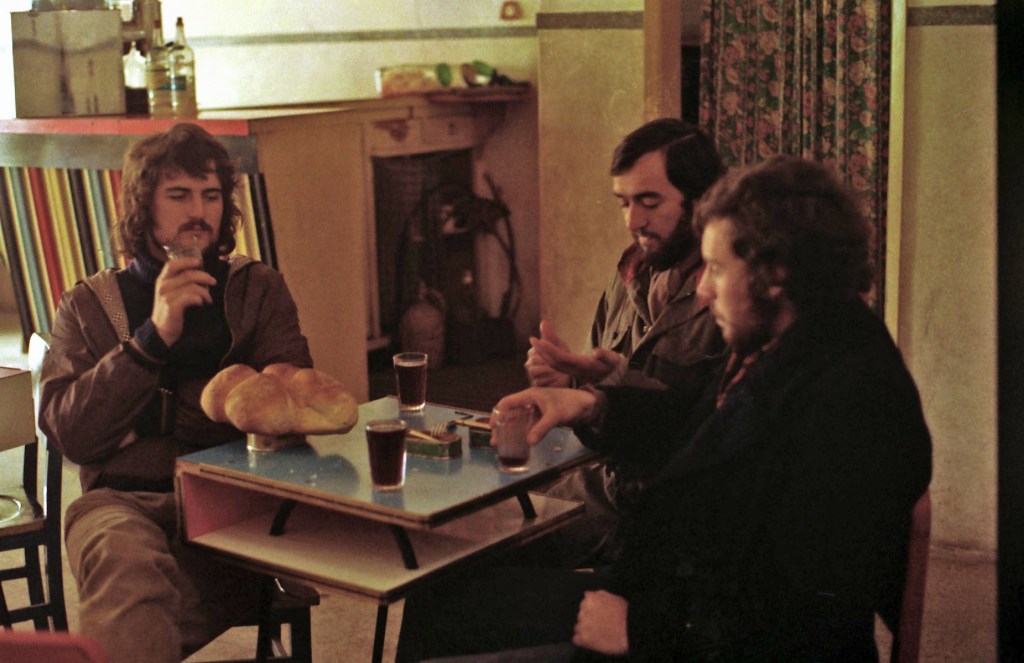
We are shouted free vino and aniz at the station cafe and wait or the train to Lisbon. Second class, 116escuados.
It will take us right across the country for little more than one section on the high-speed Targa, an express train for that era.
What a trip … hilly country. Rocks and light green coloured pines. The clickety-clack of regional rail.
We pass a derailment and the night closes in.
The carriages are a series of cabins opening off a corridor … like in the classic old-style movies.
With us is a local soldier enroute to Angola. We offer to share our bread and sardines, vino.
At first he’s reluctant but then he joins in and offers some sausage from its paper wrapping.
Presumably it’s been given to him by his mother for the trip. He is probably unsure of it being a worthy contribution to the collective meal but he is soon put at ease. It’s a nice meeting.
Dan and Roger are from the central plains of Canada, whereas Trevor and I are from Australia’s eastern seaboard.
Dan has been telling us about Portugal’s involvement in Angola at that time.
The West African country had been a Portuguese colony since the late 1400s – earlier than Magellan’s circumnavigation of the world in the early 1500s,
This was a war of independence in one of the few Portuguese colonies still remaining in the world.
Mozambique was about to go, as soon as the Portuguese finished building a major dam, Dan tells us.
He has found these things out while travelling in France and Germany.
Angola’s independence followed the Carnation Revolution in Portugal in 1974 – a peaceful overthrow after nearly a half-century of authoritarian rule.
The revolution got its name from the fact that almost no shots were fired, and from restaurant worker Celeste Caeiro who offered carnations to soldiers when the population took to the streets to celebrate the end of the dictatorship.
The 2013 movie and best-selling novel Night Train To Lisbon backgrounds the events, in which a university professor traces a young woman, her bright red coat and a 40-year-old book – in Portuguese – about the attempts to overthrow the dictatorship.
Just like in the Basque region of Spain earlier in our journey we have been travelling through places of political upheaval. Yet at no time did we feel threatened.
As colleagues would later say, always keep a low profile when in other countries. Dress down and blend in.
I guess four colonials travelling second and third class did just that … blend in
That’s the thing with travel. No one way is better than the other. Hitching takes you to many varied places. More often than not you end up somewhere other than where you plan.
But it’s the journey that’s enjoyable. Who is going to pick you up, where are they going to take you.
Like walking the streets of London instead of catching a bus. By getting lost you find yourself … find yourself in laneways you would not otherwise have trod. In museums and art galleries you would not otherwise have sheltered in from the rain. In churches you would not otherwise have rested.
If you drive by car you are in control of your journey. You can take a turn here. Go to a town there, stop off at a beach.
The trouble is you are confined to the inside of the car, talking to your fellow travellers. Social interaction is restricted to a motorway service station and restaurant or where you stop for the night.
That is unless you slow down, take the secondary roads and are prepared to stop and smell the new-mown hay.
A train takes you where you want to go. Again, you do not know who you are going to meet along the way. But you are pretty much restricted to the twin lines of steel.
We roll through the night. The screech of the wheels against the tracks as we wind our way down towards the coast … and the ship waiting to take our new acquaintance on an unknown journey to an unknown country far away from the snow-capped mountains of his home.
Our guitar is soon joined by our young soldier’s mouth organ, and then a young boy of about 10 from along the corridor with his accordion.
He loves to watch his reflection in the mirror above the seats in the carriage. One day he may get on Portuguese television. Soon the whole carriage has joined in. I poke my head outside the cabin. The corridor is full of people singing, a woman is jigging away … with her baby asleep on her shoulder.
A truly unforgettable moment. People of all ages and from different backgrounds joining in to make it a journey of a lifetime.
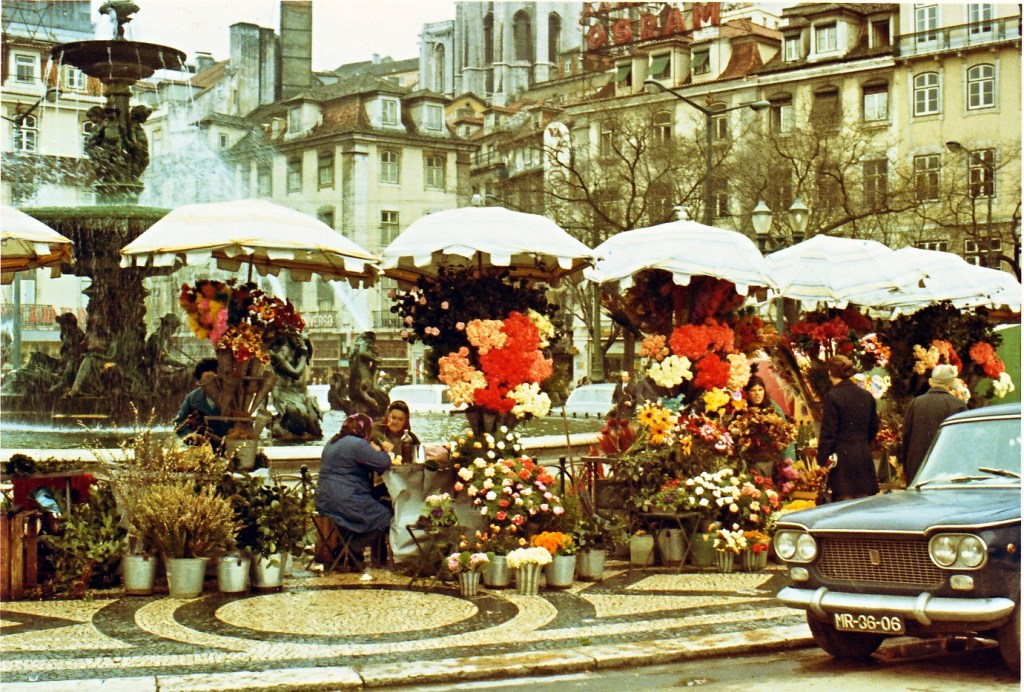
Eventually the train winds its way into Lisbon about 2am. We have slept little but walk into the city centre and sit around the fountain until the cafes open about 6am.
The flower-seller has set up. The young men tell us they want to go one day to America.
“Why?” Dan asks.
For the cars, the money, the life they see on television and in the movies, they reply.
There is a sprinkle of light rain in an otherwise warm morning. Lisbon looks like a nice place.
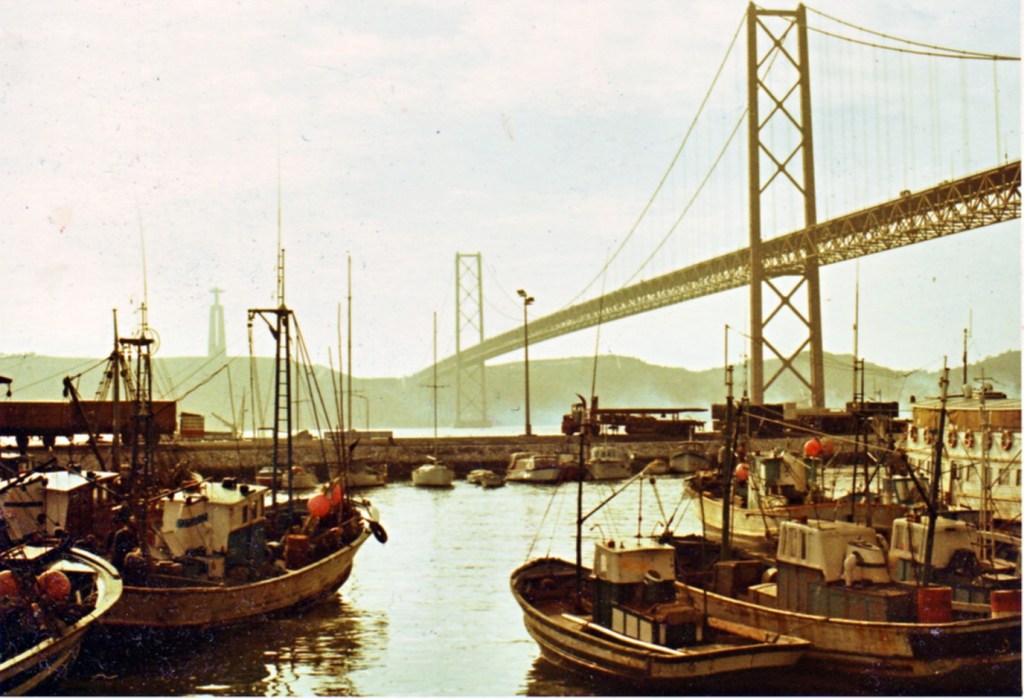
Surrounded by hills that overlook the harbour and iconic bridge.
Explorer Christopher Columbus lived in Lisbon before his epic voyage from Spain in 1492 to seek a western sea passage to the then East Indies.
Instead he started the European discovery of the Americas. And showed that the world was round … not flat.
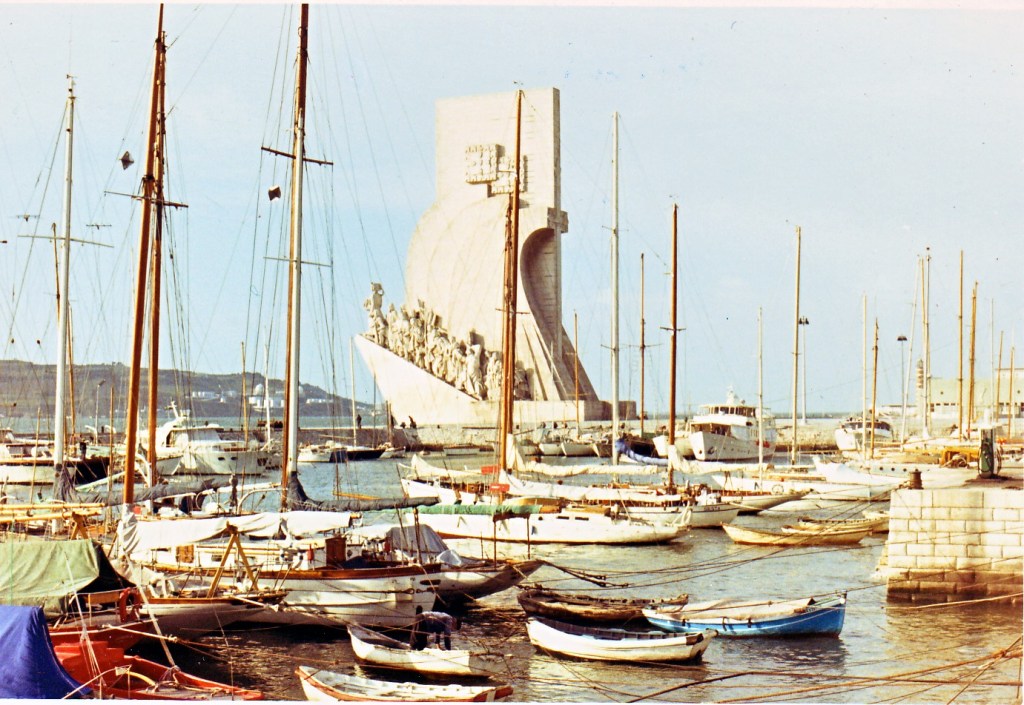
There are monuments to the early navigators along the waterfront. The ship to take the soldiers to Africa is moored in the harbour. What must our young friend think? What lies await for him?
While having breakfast at a bar-cafe we watch the trams make their way along the cobbled streets. Young boys jump on the back and ride for free.
We catch a suburban train to Oviers, after a free coffee from the bar-cafe owner.
The hostel is eventually reached, after asking many directions. The Portuguese language is different from the Spanish we had been getting familiar with.
The hostel … we cannot believe it. Right on the coastline and more like a hotel – especially at just 15 escuados a night.
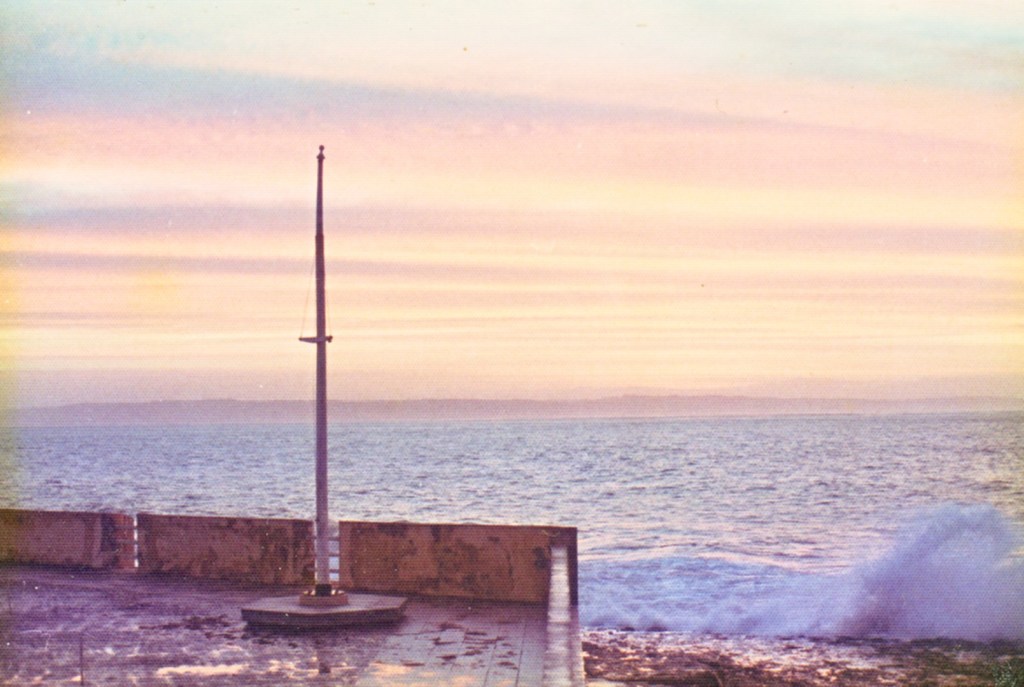
Red sky at morning … sailors warning. It’s a glorious sight.
To sit upon the sea wall and watch the waves cascade over the rocks along the shore. These swells have marched right across the Atlantic Ocean.
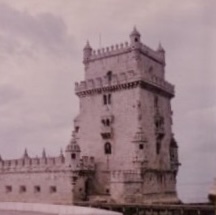
We are drawn back into the city for the day to explore this historic port.
We walk around the waterfront. It’s always the best place to catch a glimpse of the colour of a place, Dan says. Train stations generally have the cheapest accommodation near them.
He has this idea of getting a fishing boat and sailing to the Mediterranean. The countries take on a different aspect when you approach them from the sea, he says. Another time, another life and I would go with him.
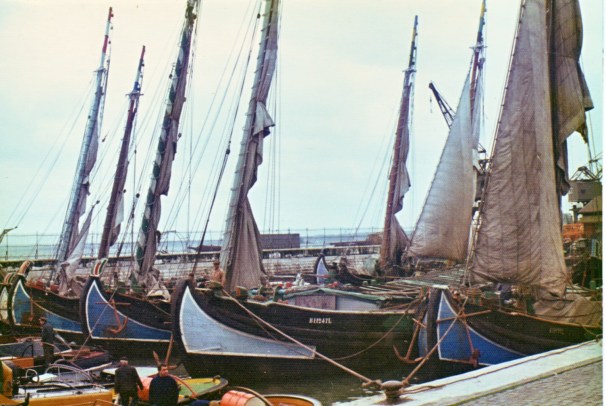
We watch the women cleaning fish, the brightly painted fishing boats and barges on the harbour, the ships loading cargo.
Through streets narrow and stepped we wander, washing hangs out from windows.
We meet an old couple from San Diego. And wouldn’t you know it, she was originally from Moosoman, Dan’s home town in Canada. Where it gets down to 40 below in winter and the old men sit on the bench in front of the store and pass the time of day. “Sure is a corker,” one will say. “Sure is,” replies the other.
We watch the surf go to waste at St Amaro and the seabirds flying … the troop ship prepares to leave. Women cry. How many wars … how many sons will not return?
It starts to rain. The red sky warning comes true.
Sitting once again in a railway waiting room. Alone with my thoughts. For three hours. Until the ferry takes me across the harbour to the train that will take me south to Lagos on the southern coastline.
 leavearly