A train journey through Spain in a long-gone era
Spain in the early 1970s was a different place, a different time … Franco was still in charge with his repressive regime but there were political tensions from such groups as ETA – Euskadi Ta Askatasuna.
These tensions were based upon the Basque region of northern Spain and Southern France seeking independence.
The Basque conflict is traced back to the Spanish Civil War in the late 1930s that saw Franco’s regime having suppressed Basque language, culture, and political expression.
During the civil war, Nazi Germany’s Luftwaffe bombed the town of Guernica on behalf of Franco’s forces.
That bombing led artist Pablo Picasso to create Guernica – a powerful anti-war oil painting depicting civilian suffering.
The struggles for Basque separation is not to be confused with the move for a Catalan independence – the region to the east with Barcelona as its centre.
A Catalan Republic was proclaimed in 1931 but during the civil war Franco abolished its autonomy.
The latest independence movement started about 2009.
It was through the Basque region that we were making our way. A couple of backpackers on a journey from London to the southern Spanish city of Malaga on the Mediterranean Sea.
We had left the coastal city of San Sebastian, and after Bilboa – the largest Basque city – it became very hilly terrain.
As the only two passengers on the bus it seemed like we were on a night ride to hell. The driver is all over the place, at times hitting the concrete blocks on the edges of the road designed to stop vehicles from plunging down the steep cliffs.
It was good to safely reach Santander and stay the night. The next day we caught the train inland to Valladolid, which was the capital of 17th-century Spain.
Yet here we were in the 1970s – it was a time before smart phones and cash cards.
To make a long-distance telephone call you needed to be at a post office or phone box, and book it through an operator.
For money, there were travellers cheques or bank and wire transfers … otherwise cash. Each European country had their own currency – not the euro – and you needed to pass through passport control as well as customs at each border.
There was only cameras with film to take travel photos … no digital camera cards. We would wait until back in London to get the film processed and the prints done.
We took selfies by setting the camera on time exposure and then rushing to get into place in time.
There was no such term as a “selfie”’ at the time … that came much later. It first appeared online in an Australian forum in 2002.
At the Santander railway station we had met two Canadians and shared our provisions of rolls, meat, fruit – together with the domestic wine from the goat-skin bags you would drink from by raising it above your head.
Dan was from Moosomin in southern Saskatchewan, and Roger … I think he was originally from Toronto.
We shared stories about the differences yet similarities of our home regions. Canada’s mid-west had snow and ice whereas Australia’s inland had sand and rocky desert for the most part.
“Sure is a corker,” was an expression heard in Canada when temperatures dropped to 40-degrees below freezing.
“Sure is,” an Australian would say when the mercury rose to 40-degrees above.
It is a steady climb up to the plateau that covers a major part of north-western Spain.
We’re travelling 3rd class up into the mountains. Snow and permafrost covers the fields.
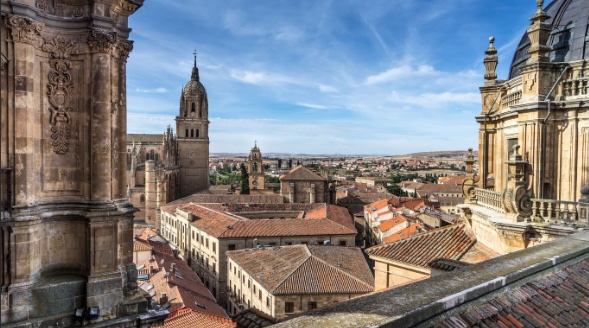
Valladolid is home to some significant architecture from its time as capital.
While Dan and Roger prepared to hitch, we were going to wait for a midnight train to Lisbon.
It was siesta time and not many people were on the streets but eventually we managed to buy some more food for the train journey.
To our surprise, Dan and Roger were waiting at the station. They had given up on the idea of hitching a ride.
There were six hours to kill and by now everyone was walking around town.
There are gum trees in the park … even a statue of a kangaroo. The Canadians could not understand the reaction two Australians had to these symbols of the land at the other end of the Earth.
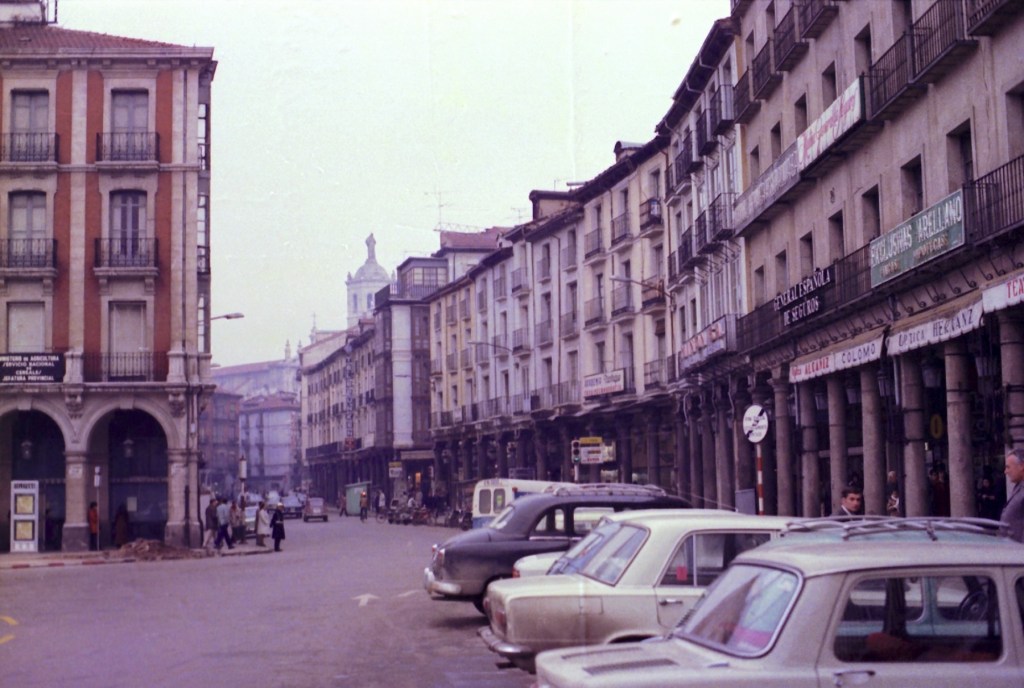
Into a crowded bar. The shops close about 9pm but the bar stays open.
We walk down the darkening streets and into the station. For 15 pesatas we can get four photos taken at one of those little booths with a draw-string curtain.
After much rehearsing we figure we can get one snapshot each … if we line up and make the right moves.
By this time there’s a small crowd gathered around watching. Right. First man in. One, two. The flash goes off. Next!
And so it goes until all four have had their turn. Then it’s time to wait and see the proof of our little episode.
Finally there’s a whirring noise and the strip of paper starts to come out of the slot. It’s worked. Everyone seems pleased. Even the group of onlookers. These crazy foreigners.
Still, it’s filled in time and given each of us a lasting momento of our walk into Spain.
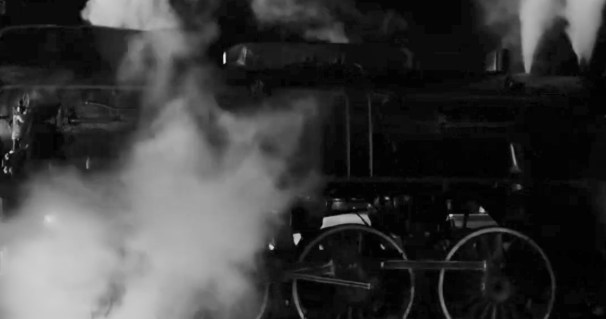
Then, like something out of a movie, the train arrives in clouds of steam.
The big black engine heaves and pants like some enormous creature. We climb on board and sit cross-legged in the corridor of a carriage. Second class this time, to Fuentes ‘onoro … the Portuguese border.
The steam train pulls out of Villadollid station at 0.42am. We share ham rolls, vino and duty-free whisky.
After Medina del Campo we get to ride in a dog-box cabin with three Spaniards to the Portuguese border.
They show us their magazines and tell us about Spain. We have common themes in the World Title featherweight boxing fight between the Cuban-born Spaniard Jose Legra and Australia’s Johnny Famechon in the ring, Rod Laver and Manuel Santana on the tennis court.
The Spanish trio left the train at Salamanca, a beautiful city of learning. And we half-slept to the end of the line.
It’s 5.45am on a cold, wet morning. We are sitting in a remote railway station waiting room.
The border crossing into Portugal is a little way from the station. There is snow on the ground but the lights are on.
Again, the setting is like a movie … in black and white, not colour.
We wait until 8am when the border opens. And walk through the snow into Portugal.
The trouble is, we have already been waiting in Portugal and are approaching the counter from the wrong side.
The border guard can’t work it out … it’s as if we are trying to cross back into Spain.
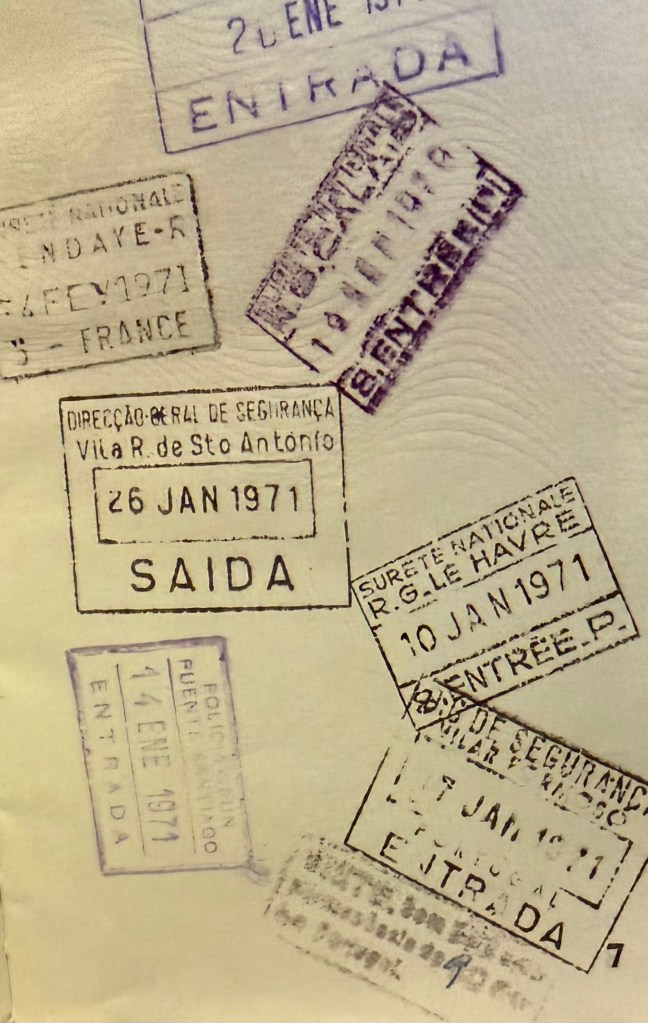
Eventually, after some broken Spanish, English and bits of French – and a lot of hand gestures thrown in – he stamps our passports. We change money and make our way on to the Villa Formosa station.
The cost of a ticket to Guarda is 70 escuados. The snow brings with it a silence … broken only by our footprints.
We are travelling first class with an American who is attending university in Rome, and an interesting Portuguese guy on his way to Sao Paulo in Brazil.
The country slips past us. We slide through it like a snake of steel.
It’s poor country. High country. Guarda is covered in snow.
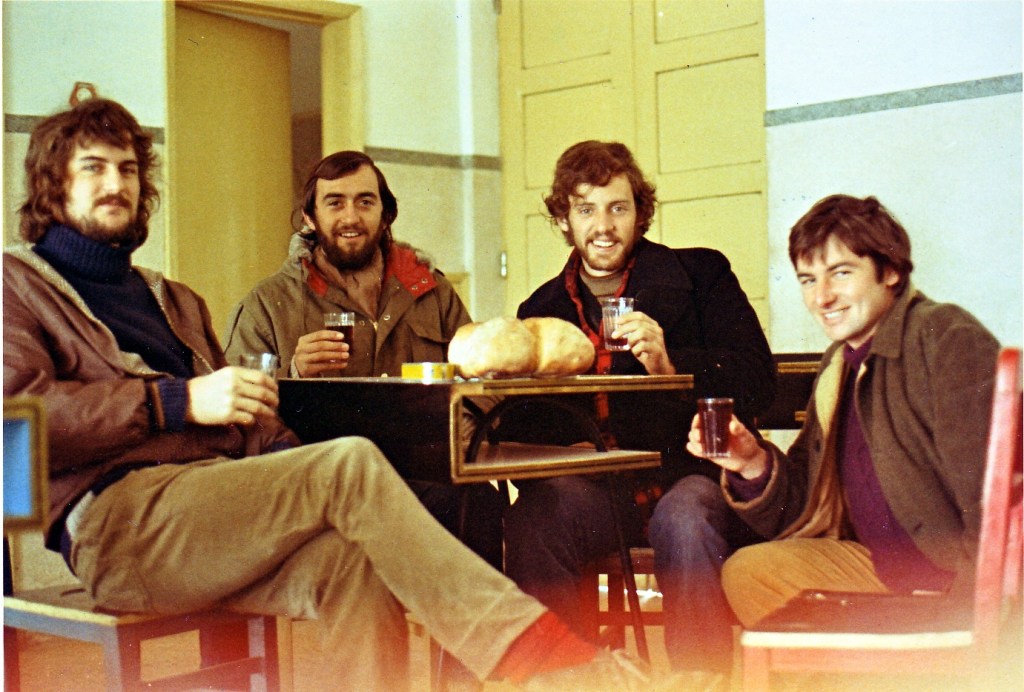
The village is higher up the mountain than the station. Some local lads take a look at these interlopers who are far from the well-trodden tourist routes.
We buy food at the cafe and walk the 5km uphill to the village and hopes of a hostel. After trudging through the snow and rain, we arrive soaked through.
We’re a curiosity here. They must wonder why anyone would be out in such weather.
Yet it’s a real adventure. It’s days like this that you remember. They change your outlook. For without the bleakness, how will you fully appreciate the sunny days.
The hostel doesn’t open until late in the afternoon and it’s midday. So we talk to a young man about the cost of staying at a hotel.
Most folk seem to be able to speak some French. It seems strange. There is no affinity with Spain. Both say the other stink. I realise that it goes back hundreds of years.
The hotel is 100 escuados for lunch, dinner and a bed. They are terrific meals and I reflect on them while lying on the floor of the drying room.
Lunch was potato soup with some greens in it. Bachalard was a fish dish with salad. Nice wine. Then we had egg, potato, greens and sausage done their way. It was followed by banana and orange – with cognac to prevent pneumonia.
I remembered those long-ago documentaries of Portuguese fishermen who spent 300 days of the year at sea, fishing from dories mid ocean and returning at night to the mother ship. They survived on fish. Poached fish, fried fish, smoked fish, baked fish.
Much the same as sheep or cattle in Australia. If you are on a sheep farm in western Queensland you have meat nearly every day of the year. You don’t call it mutton, you don’t call it lamb. You call it meat.
We slept till 7.30pm then had dinner at 8. Vegetable soup, wine, fish patties and rice. For main course it’s pork, fried chips, greens and olives followed by fruit and cola. Roger plays the guitar.
The drying room was a beautiful place. We talked with the young man who negotiated our staying at the hotel and his friend, a young girl who worked at the hotel. She plays the guitar as well and we all play cards together.
A wonderful time in a secret part of the world.
 leavearly