A backpackers wanderings in the 1970s

It was a time of change – the Berlin Wall divided the key German city. We had lived through the Cuban Missile Crisis and the threat of nuclear war. Woodstock had turned the music industry on its head and opened up many different lifestyles, perhaps nowhere more than London.
It was the 1970s and we had been living and working in the capital of the United Kingdom for six months or so … transferring manual data entries onto the early computers.
As winter started to change to the first days of spring, most of our group of Australians who had been working together decided to head south – to the Mediterranean.
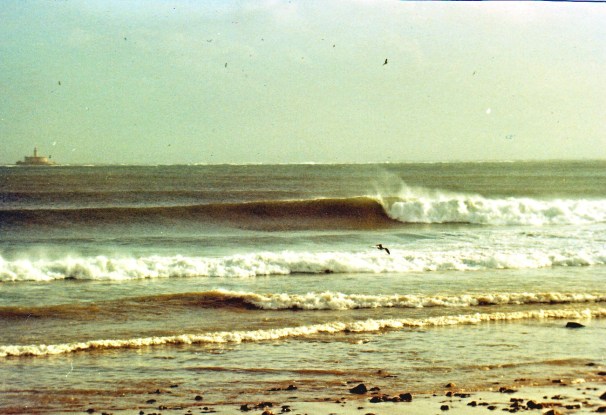
Five travelled in a van, while two of us decided to travel the best way we could.
Hitch-hiking through France quickly became the need to catch buses and trains. Sleeping in a tent where we could, and at railway stations when it was raining.
The plan was we would all meet in Malaga, Spain, dropping by the post office each day at 10am.
That was why I was on a night train south from the Portuguese capital of Lisbon, headed for Lagos on the southern coastline.
There is something about a night train ride … looking out the window at the darkened landscapes rolling by. These are times to reflect on life so far – the people who have been a part of it. The fact that I’m on a train on the other side of the world to where I was born.
Yet there is also the excitement of what is ahead.
Who could have imagined the things we had experienced in the past 10 days or so since crossing the English Channel by ferry to Le Havre.
The train must have arrived about 10pm. There were not many fellow passengers and the streets were soon deserted as I walked towards the beach.
Cobbled streets, whitewashed houses. Then the coastline – dramatic cliffs dropping down to the sea,
I made my way down and found an overhang not too far along the sand in which to get some sleep. Just far enough from the town not to bother anyone.

Here I was in the land of cork trees and almonds.
The Algarve is that 160km southern stretch of Portugal that links the Atlantic Ocean with the Mediterranean Sea. It also links its vivid Moorish past with its lively Portuguese lifestyle.
The south-west corner of Europe, where a rugged range of mountains cut the region off not just from Portugal but the rest of Europe.
Not any more. People from all around the world seek its sandy beaches at the base of rocky golden cliffs.
I wake at daylight and make my way back into town, past the stone walls of fences for the orchards of almond trees, fig trees, the farm cottages with their decorative chimneys.
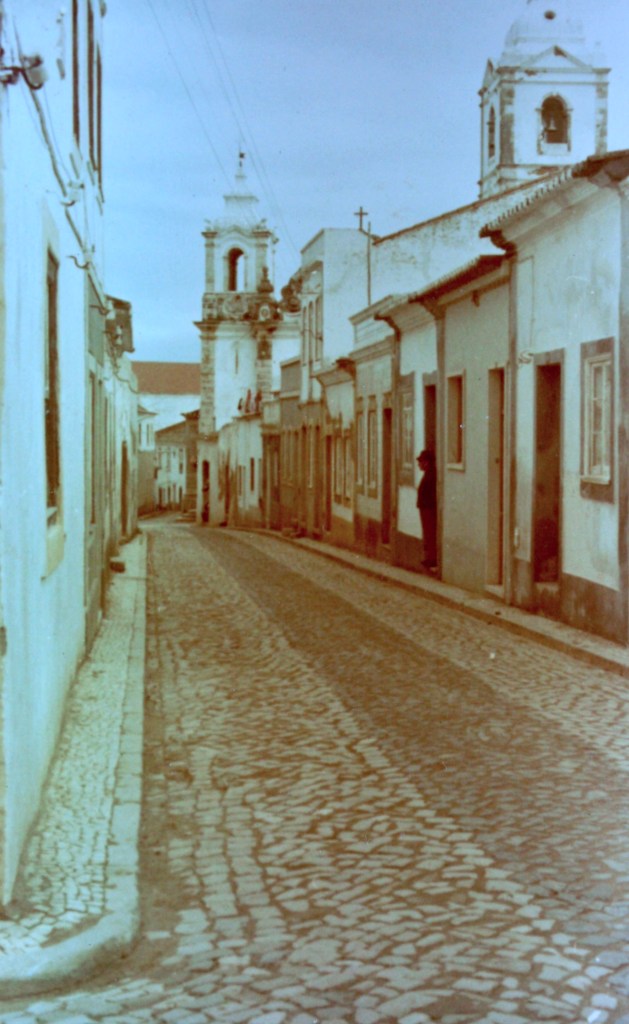
Then there is the wonderful smell of fresh bread baking that draws me back into the cobbled streets of the village.
A loaf of bread is a good companion for a traveller. And some cheese. Maybe a piece of fruit.
Lagos is toward the western or Atlantic end of the Algarve and I’m leaving and its white-washed houses clustered together to form a fishing village.
I could walk all morning in this rural wonderland. Leaving the cobbled streets full of spring. It’s late January and the almond trees are in blossom. Citrus trees are in fruit. There is a beautiful smell in the air.
Few cars. Mainly motor bikes with carry-alls on the back to take the fruits of the sea or farm produce to market. Otherwise there are bicycles. Perhaps a kilometre or so in front of me is a horse and cart heading in the same direction.
Let’s see: 4km an hour, walk for eight hours a day…that’s three, probably four days to the Spanish border. I can do that if I have to. I can do that if I want to. Let’s just see how it pans out.
People walking in the opposite direction say hello.

Bom dia, good day, is shortened to dia or dio.
My borrowed green coat and Jack Elliott’s cap seem to have let me fit nicely into the landscape.
Perhaps that’s why I can’t get a lift. They think I’m a local … heading out to work.
The coat was given to me by a lady in Holland we stayed with for a couple of nights on the road trip to Munich Beer Festival in late September.
The coat was either her husband’s – he worked in the mining industry in South Africa – or her son’s.
They lived in The Hague and she had a daughter, perhaps in late 20s, who showed us a bit of what was happening at Hook of Holland one night.
That’s where the van we were travelling in was broken into. Well, not really. They just had to slide the window open and take some clothing.
That’s why I was given the coat.
After an hour or so I have caught up with the horse and cart and say “dio” to its driver. Too bad that my Portuguese is so poor. After a few weeks in Spain I was starting to pick that language up. That’s why I’m having so much trouble with this one.
The Portuguese and the English seem to have a good understanding … probably as mutual allies against the Spanish in the days of the Armada. I think the Spanish and the Irish had an alliance that at times extended to Scotland.
Portimao is about 15kms from Lagos and I have set my sights on Praia da Rocha, perhaps the most famous beach on the Algarve.
Then an architect in a snappy Alfa sedan stops and gives me a lift … all the way to Armacao de Pere. He’s an interesting person and it’s good to have a conversation in English. I tell him how much I like this area … the fishing villages, the small farms. Yet he says to forget the romance. The people need work to keep up with the other European nations.
Coffee and a roll overlooking probably the largest beach on the coastline. Afterwards, I walk back to the main road and then get a lift in the back of a sand truck.
The cloud turns to misty rain as I stand at the turn-off to Albufeira, wondering which road to take.
The first ride was in a van but the driver was headed inland for Loule so I decided to stick to the coast. The next lift takes me to Faro, the main town on the Algarve and home to the airport.
Yet it is a bigger place than I want. The countryside has been nice despite the rain but the big town and the rising wind has an unsettling feel.
So I catch a bus for Olhao. But it’s just as bad. It’s like running before a storm.
Another bus to Tavira. Then walk off into the night looking for the beach, hoping to find a hostel there or the verandah of an unattended house to sleep on.
The beaches are different. Not the high cliffs and sandy bays of Lagos but low dunes and shallow water.
The village is much smaller than I expect and there are few lights on.
That’s when an armed policeman steps out of the shadows and asks my business. I try to communicate in Spanish but with little luck. It only seems to make him more suspicious.
So I retrace my steps back into town then head a few more kilometres towards Spain.
It’s late … about 2300 hours … yet the night is clearing and I find a place beside a stone fence and beneath a lemon tree. The sky is filled with stars. Sounds carry. I can hear the sea.
I awake at 6 and start walking. There’s nothing like tiredness to make the ground feel like a feather bed.
A lemon starts the day. The moon is in its first quarter and hangs in the sky with the lightening sky. The trees are silhouetted against the changing backdrop … purple through to faint red to greying blue. Broken only by the stars, the lights of a distant village and the sweep of a lighthouse.
The stillness is disturbed from time to time by sound of roosters crowing and the whine of a motorbike in the distance. The rumble of a train cuts through the mist below the ranges.
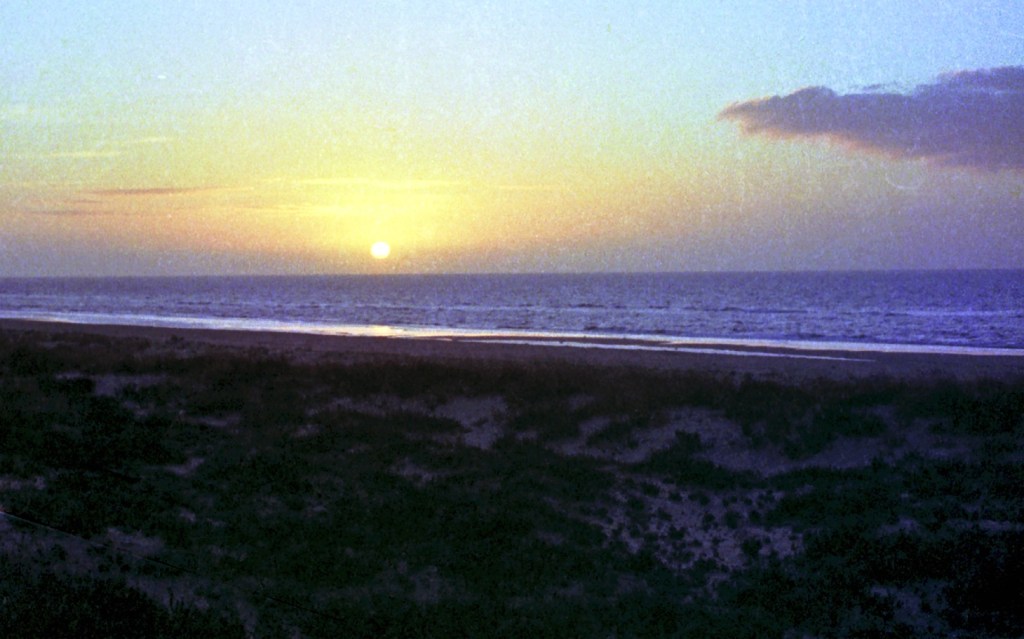
It gives rise to a beautiful day. The sun fills a cloudless sky. I’m walking through blossomed groves of trees. “Bom dia” again comes from everyone I pass by – whether idly watching my progress or on their way to task. Sandy beaches, clear water again. I set up camp in the dunes behind some low scrub … like we used to in Oz. Surfboards beside the car. Oh, they were our roaring days.
The sun lulls me to sleep.
I am at Praia de Monte Gordo, near the mouth of the River Guadiana. From here you can see the Spanish border. I am making good time. Half way through January and two thirds of the way to Malaga and the planned rendezvous with the mob from London.

Grab some oranges from the trees on the way into the village. From the patio of a bar-cafe I watch the locals walking through the village square.
It’s a Sunday evening so it looks like the remnants of a time-worn ritual. The men and women pass each other by.
The disorderly wandering takes on an order. The men walking one way and the women the other … like a dance. Greeting each other and making friendships.
Tourist hotels stand side by side with fishermen’s cottages. Bar-cafes with churches.
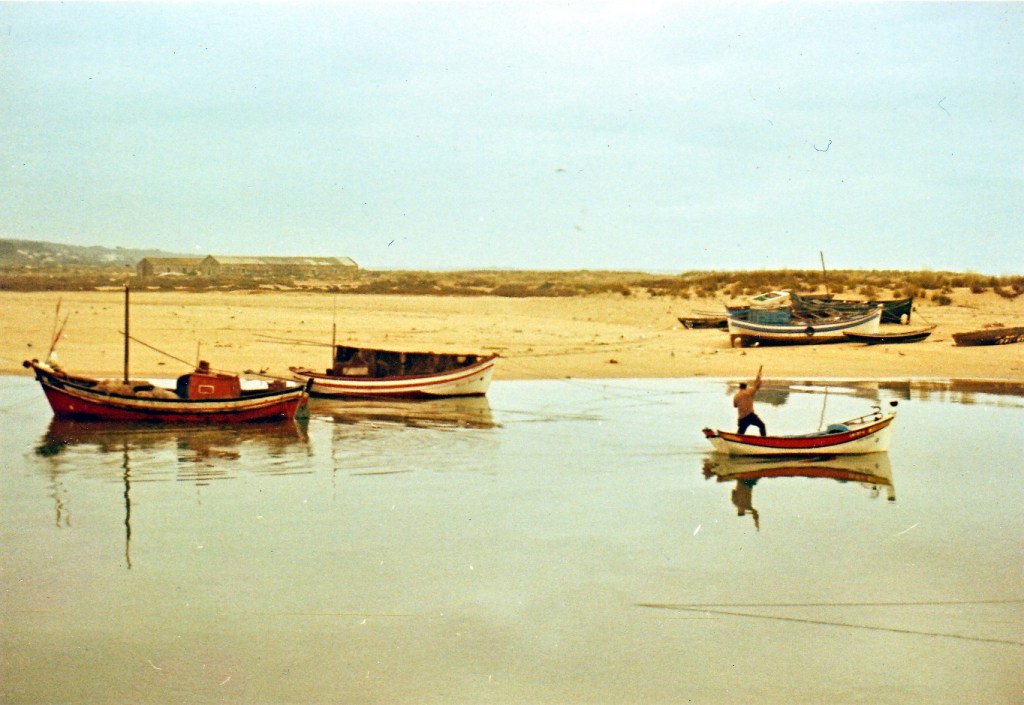
On the beach lay brightly coloured fishing boats with their upturned bows and prows.
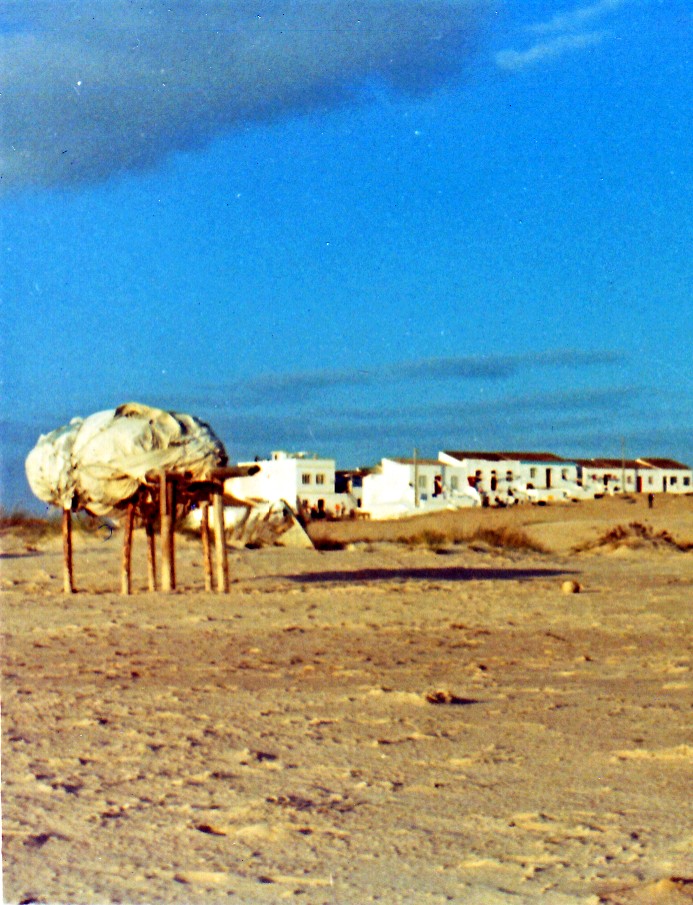
To sleep under the exquisitely perfumed pines which reach the golden sands of the beach washed by clean ocean water. To wake and swim, even shave and wash your teeth in the sea.
To sit again the next morning on the patio of the bar-cafe and eat ham rolls, sip coffee, write letters. Talk with the locals or the holidaymakers from England or Germany who are staying at the hotel.
Sitting. The dark surface of the coffee allows me to reflect on my life so far. To think as others may see me. To re-evaluate my life.
The next day I walk into Villa Real and catch the ferry into Spain.

 leavearly
Hi Erle, Thanks for that! Amazing! Wishing you a wonderful Christmas time! Bettina
LikeLiked by 1 person